Edwin Scheier
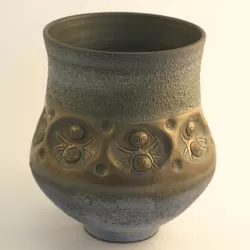
Mary and Edwin Scheier are known for finely thrown functional vessels with sgraffito or applique surface decoration.
Mary became an expert on the potter?s wheel, throwing thin earthenware pots. Edwin decorated the works ...
Read more
Typical Marks
About
- Biography
-
Mary and Edwin Scheier are known for finely thrown functional vessels with sgraffito or applique surface decoration.
Mary became an expert on the potter?s wheel, throwing thin earthenware pots. Edwin decorated the works using motifs that reflected his interest in spirituality and anthropology.
The Scheiers were both largely self-taught studio potters who worked together throughout their 69 year marriage. Mary and Edwin made individual works, however, these are often indistinguishable and difficult to attribute.
The Scheier?s early work is characterized by domestic wares with simple geometric motifs and soft glaze colors inspired by Appalachian Folk Pottery. At their first pottery in Virginia, Hillcrock Pottery, they primarily made small figures and functional wares.
In 1940, the couple moved to New Hampshire to teach at both the University of New Hampshire and the League of New Hampshire Craftsmen. It was during this period in New Hampshire that the Scheiers created their most prolific and mature works.
During World War II, Edwin served as a merchant seaman. When he returned from the war, he began to use new imagery inspired by the tattoos he had seen abroad. These motifs recurred throughout his career along with imagery depicting fertility, regeneration, primitivism and creation. While Edwin was absent, Mary continued the pottery in New Hampshire. During this time she made a series of coffee pots and matching cups decorated with a restrained use of glaze, allowing the grainy texture of the clay body to show.
After the War the University of New Hampshire, like many other universities across the country, responded to the influx of students using the G.I. Bill for their tuition, by expanding their ceramics program. Edwin was invited to teach and Mary became the school?s artist-in-residence.
In 1968 the Scheiers retired and spent nearly a decade in Oaxaca, Mexico. They studied weaving and Zapotec pottery. Imagery from this experience began to appear on their works from this period and later. They lived and worked in Green Valley, Arizona for the remainder of their lives.
" - Apprenticeships & Residencies
- Primary Work Experience
-
1937
Instructor, Crafts and Puppetry, New York State Civilian Conservation Corps
1937Field Supervisor, Works Progress Administration, Kentucky, Virginia and North Carolina
1937Hillcrock Pottery, Glade Spring, Virginia
1938Federal Art Project, Norris, Tennessee
1940-1968Professor, Ceramics, University of New Hampshire, Durham, New Hampshire
1940The League of New Hampshire Craftsmen, Concord, New Hampshire
1968-1978Studio Potter, Oaxaca, Mexico
1978-2008Studio Potter, Green Valley, Arizona
Other
1937—Married to Mary Goldsmith
- Public Collections
-
American Museum of Ceramic Art, Pomona, California
The Art Institute of Chicago, Chicago, Illinois
Arizona State University, Art Museum, Tempe, Arizona
Brooklyn Museum, Brooklyn, New York
Baltimore Museum of Art, Baltimore, Maryland
Cincinnati Museum of Art, Cincinnati, Ohio
Cleveland Museum of Art, Cleveland, Ohio
Cranbrook Academy Art Museum, Bloomfield Hills, Michigan
Currier Museum of Art, Manchester, New Hampshire
Detroit Museum of Art, Detroit, Michigan
Everson Museum of Art, Syracuse, New York
Metropolitan Museum of Art, New York, New York
Museum of Arts and Design, New York, New York
Museum of Fine Arts, Boston, Massachusetts
Museum of Modern Art, New York, New York
Newark Museum, Newark, New Jersey
Philadelphia Museum of Art, Philadelphia, Pennsylvania
Museum of Art, Rhode Island School of Design, Providence, Rhode Island
Scripps College, Claremont, California
Smithsonian Cooper-Hewitt National Design Museum, New York, New York
Southern Highland Craft Guild, Asheville, North Carolina
Museum of Art, University of New Hampshire, Durham, New Hampshire
- Bibliography
-
Clark, Garth. American Ceramics: 1876 to the Present. New York, NY: Abbeville Press Publishers, 1987.
Dietz, Ulysses Grant. Great Pots Contemporary Ceramics from Function to Fantasy. Madison, WI: Guild Publishing with the Newark Museum, 2003.
Falino, Jeannine. Crafting Modernism: Midcentury American Art and Design. New York, NY: Abrams, 2011.
Komanecky, Michael K. American Potters: Mary and Edwin Scheier. Manchester, NH: The Currier Gallery of Art, 1994.
Levin, Elaine. The History of American Ceramics from Pipkins and Bean Pots to Contemporary Forms. Harry N. Abrams, Inc., Publishers: New York, New York, 1988.
Perry, Barbara, ed. American Ceramics: The Collection of Everson Museum. New York, NY: Rizzoli International Publications, Inc., 1989.
- CV or Resume
- Website(s)
Citation: Edwin Scheier, "The Marks Project."
Last modified April 29, 2026. https://www.themarksproject.org/artists/edwin-scheier
Objects




Collections
American Museum of Ceramic Art (AMOCA)
Pomona, California
-
American Museum of Ceramic Art (AMOCA)
Pomona, California
Everson Museum of Art Collection
United States
-
Everson Museum of Art Collection
United States -
Everson Museum of Art Collection
United States
Mr. and Mrs. Fred Marer Collection, Scripps College
Claremont, California
-
Mr. and Mrs. Fred Marer Collection, Scripps College
Claremont, California
