
John Glick
John Glick is known for functional, thrown, stoneware vessels with painterly surfaces. His early work reflected his Cranbrook teacher, Maija Grotell, and is characterized by simple, undecorated stoneware dinner services and functional ...
Read more
Typical Marks
About
- Biography
-
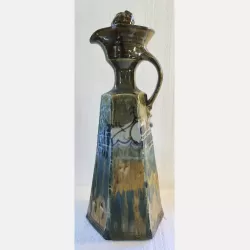
John Glick is known for functional, thrown, stoneware vessels with painterly surfaces. His early work reflected his Cranbrook teacher, Maija Grotell, and is characterized by simple, undecorated stoneware dinner services and functional vessels.Glick founded Plum Tree Pottery in 1964. There he produced a range of functional vessels with sophisticated painterly decoration. The surface is drawn on and painted with slips and glazes, frequently with flower and vine motifs, sometimes built up to form relief or textured underglaze surfaces, always creating the illusion of depth.
Toward the end of the 1960s, his work began to reflect his interest in 18th and 19th-century Japanese art and contemporary Abstract Expressionism. Beginning in the 1990s, in an effort to get larger surfaces, he made landscape-inspired wall panels.
Glick is considered one of the most important functional potters of his time, not only for his body of work but also as an influential teacher and mentor. Glick introduced, to American studio potters, innovative studio practices that have been widely adopted. He worked with studio assistants, initially having them throw the desired forms or assemble the slabs of hand-built forms to his specifications. Glick concentrated on all aspects of the decoration and finishing.
Initially, Glick used a simple bleed through of iron spots, he later developed a catalog of motifs using combinations of wax resist patterns, incised lines, stamped textures, stain, oxides, and glazes, brushed on, dipped, and dripped to create abstract expressionist surface designs. He created tools to do specific jobs, for example extending the sides of wheel-thrown pots with wooden rib supports. Glick gave new life to forgotten tools such as the extruder, first used in the 18th century to produce straps in various profiles for jug, can, and teapot handles. Glick repurposed the extruder to make sections of his slab built forms. Ultimately, Glick repurposed not only traditional potter?s tools but also their functional forms, to make a unique, unpretentious artistic statement.
" - Apprenticeships & Residencies
- Primary Work Experience
-
1964
Founded, Plum Tree Pottery, Detroit, Michigan
Other
- Public Collections
-
American Museum of Ceramic Art, Pomona, California
Brunnier Art Museum, Iowa State University, Ames, Iowa
Canton Museum of Art, Canton, Ohio
Craft and Folk Art Museum, Los Angeles, California
Cranbrook Art Museum, Bloomfield Hills, Michigan
Crocker Art Museum, Sacramento, California
Delaware Art Museum, Wilmington, Delaware
Detroit Institute of Arts, Detroit, Michigan
Everson Museum of Art, Syracuse, New York
Flint Institute of Arts, Flint, Michigan
Gardiner Museum of Ceramic Art, Toronto, Canada
Hunter Museum of Art, Chattanooga, Tennessee
The International Museum of Dinnerwar Design , Ann Arbor, Michigan
Kansas City Art Institute, Kansas City, Missouri
Krannert Museum of Art, Urbana, Illinois
Los Angeles County Museum of Art (LACMA), Los Angeles, California
Mint Museum, Charlotte, North Carolina
Museum of Art, Yixing, P.R. China
Museum of Arts and Design, New York, New York
Museum of Fine Arts, Houston, Texas
Newark Museum, Newark, New Jersey
Racine Art Museum, Racine, Wisconsin
Smithsonian American Art Museum, Renwick Gallery, Washington, D.C.
- Bibliography
-
Birks, Tony. The Complete Potter’s Companion. London, England: Conran Octopus, 1993.
Clark, Garth. American Potters: The Work of Twenty Modern Masters. New York, NY: Watson-Guptil Co., 1979.
Clowes, Jody. "John Glick." American Craft Magazine, June/July, 1991.
Dormer, Peter. The New Ceramics: Trends and Traditions. New York, NY: Thames & Hudson, 1986.
Fina, Angela and Jonathan Fairbanks. The Best of Pottery. Rockport, MA: Quarry Books, 1996.
Gibson, John. Pottery Decoration: Contemporary Approaches. London, England: A&C Black, 1987.
Glick, John. “Surface Decoration and Direction." Ceramic Review Magazine, May/June, 1988.
_________. “The Evolution of Mentorship.” The Studio Potter 36, Winter 2007/2008.
_________. “Studio Management Revisited: Reflections on Working in My Studio the Last Twenty Years.” The Studio Potter 20, June 1992.
Greenland, Tim. "John Glick - A Kind of Magic." Ceramic Review Magazine, July/August 1985.
Hall, Julie. Tradition and Change, The New American Craftsman. New York, NY: E.P. Dutton, 1979.
Hamer, Frank and Janet. The Potter's Dictionary of Materials and Techniques. London, England: A&C Black, 1997.
Hopper, Robin. The Ceramic Spectrum. Radnor, PA: Chilton Book Co., 1983.
Koplos, Janet and Bruce Metcalf. Makers: A History of American Studio Craft. Chapel Hill, NC: The University of North Carolina Press, 2010.
Krukowski, Samantha. "John Glick's Journeys and Evolutions." Interview. Ceramics: Art and Perception 9, 1992.
Lane, Peter. Ceramic Form: Design and Decoration. Rizzoli, Inc., New York, NY, 1988.
Nordness, Lee. Objects U.S.A. New York, NY: Viking Press, 1970.
Pearson, Katherine. American Crafts: A Source Book for the American Home. New York, NY: Stewart, Tabori and Chang, 1983.
Perry, Barbara, ed. American Ceramics: The Collection of the Everson Museum of Art. Syracuse, NY: Everson Museum of Art, 1989.
Rau, David D.J. “John Parker Glick: The Mantel Series.” Ceramics: Art and Perception, no. 32, 1998.
Zakin, Richard. Ceramics, Mastering the Craft. Radnor, PA: Chilton & Co,1990.
- CV or Resume
- Website(s)
Citation: John Glick, "The Marks Project."
Last modified April 29, 2026. https://www.themarksproject.org/artists/john-parker-glick-0
Objects




Collections
American Museum of Ceramic Art (AMOCA)
Pomona, California
-
American Museum of Ceramic Art (AMOCA)
Pomona, California -
American Museum of Ceramic Art (AMOCA)
Pomona, California -
American Museum of Ceramic Art (AMOCA)
Pomona, California -
American Museum of Ceramic Art (AMOCA)
Pomona, California -
American Museum of Ceramic Art (AMOCA)
Pomona, California -
American Museum of Ceramic Art (AMOCA)
Pomona, California
